
Behind the Raise with Implement AI
By Toby Hicks
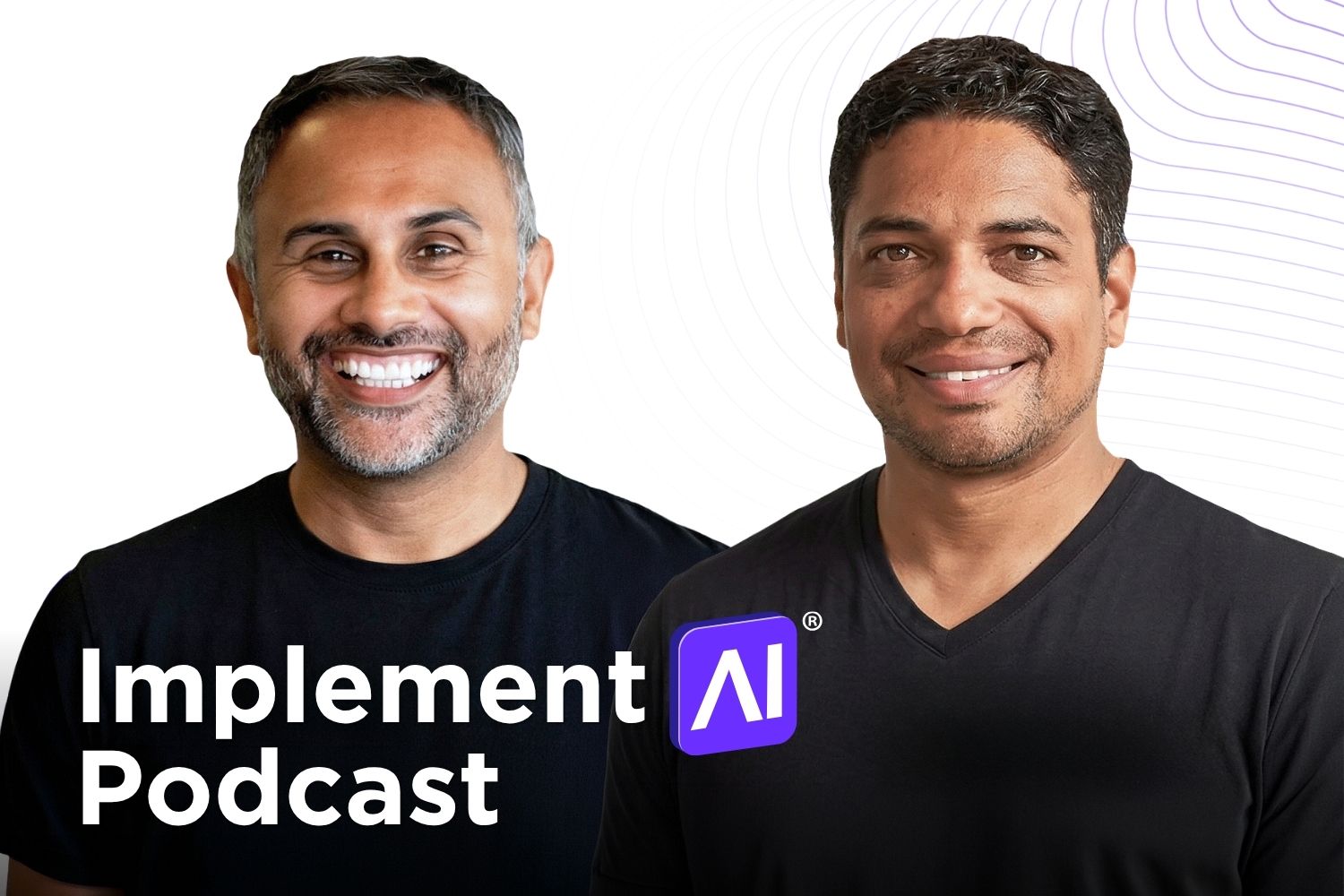
We sat down with Piers Linney, entrepreneur, investor, former Dragons’ Den dragon, and co-founder of Implement AI – a platform deploying coordinated teams of AI workers across sales, support, operations and analysis. Having successfully raised with AIN and having invested in multiple businesses over many years, Piers brings a dual perspective to the fundraising conversation. He shares how Implement AI is helping businesses decouple growth from headcount, why governance has to be baked in from day one, and how a structured process can help founders be truly investor-ready.
Tell us about Implement AI and the problem you are looking to solve?
Implement AI helps businesses deploy a digital workforce: AI workers that operate across existing systems to make calls, send emails, analyse data, support customers, update records and execute workflows.
Most companies still scale through headcount. More revenue means more people, more management and more cost. That model breaks when demand, complexity and speed increase.
AI changes that. It adds operational capacity without adding to payroll. Every business has revenue leaking daily through missed calls, slow follow-up, untouched leads and fragmented data. Not because teams are ineffective, but because human capacity is limited.
Our AIOS Workforce platform deploys coordinated teams of AI workers across sales, support, operations and analysis. Our AIOS Command product provides an executive insights layer via connected systems. Our customer systems stay the same. The difference is who is doing the work.
How can a digital workforce amplify human potential?
A digital workforce amplifies human potential by removing repetitive, time-consuming work and giving people back the capacity to focus on judgement, relationships and higher-value decisions.
In most businesses, talented people spend too much of their day chasing information, updating systems, writing follow-ups, checking reports or responding to routine enquiries. That is not the best use of human intelligence. AI workers can take on much of that work consistently, at scale and around the clock.
But this is not just about efficiency. It is about capacity. A digital workforce allows businesses to operate beyond normal human constraints. It can analyse every call, surface every missed opportunity, follow up every dormant lead and monitor every workflow in a way no human team can do economically. The result is not just less work for people, but more work getting done overall, and at a higher standard. That
changes the role of the human.
When execution and coordination are no longer bottlenecks, people focus on the work that actually drives outcomes: selling, negotiating, leading, creating, solving complex problems and building trust.
For investors, that is the real shift. This is not another productivity tool. It changes the operating model of a business by decoupling growth from headcount and introducing a new layer of scalable capacity.
How do you help businesses build the governance guardrails necessary to ensure their AI agents remain compliant and brand-safe as they handle thousands of live customer interactions?
Governance has to be built into the operating model from day one. You cannot bolt it on after an AI agent is already interacting with stakeholders. It starts with clear boundaries: what the agent can do, what it cannot do, when it needs approval, and when it must escalate. That defines controlled autonomy rather than open- ended behaviour. From there, governance is about controls. Role-based access, audit trails, confidence scoring, validation layers and human-in-the-loop checkpoints ensure accountability and
consistency at scale.
Agents are also grounded in the company’s actual policies, processes, data and tone of voice, not generic model behaviour. That is what keeps them compliant and brand-safe. Finally, this sits within broader governance frameworks, including GDPR, the EU AI Act and security standards like Cyber Essentials and ISO 27001. The goal is not perfection, but controlled, auditable systems that perform more consistently than the human alternative.
Why did you raise via Angel Investment Network?
Angel Investment Network has been a reliable source of finance across several businesses I have been involved with over the years, as a founder, investor and director. That matters. Fundraising is ultimately about trust, momentum and access, and I have found the process with AIN to be quick, efficient, and well supported.
The team also provides objective feedback. Angel Investment Network provides amazing access to a wide base of investors with different backgrounds, different sector expertise and different geographic perspectives. The network now spans 90 countries and includes more than 388,000 investors globally, which gives founders a much broader surface area for relevant conversations. That is useful because the right investor is not always the obvious one already in your immediate network.
For a business like Implement AI, operating in a fast-moving and sometimes noisy market, that reach is valuable. We needed investors who could understand both the scale of the AI opportunity and the practical execution challenge. AIN helped us reach people who were actively looking for opportunities and who could engage with the proposition quickly.
For founders thinking about raising, Angel Investment Network rapidly broadens the funnel, enables you to test your story and find aligned capital.
The AI landscape is moving at breakneck speed. When pitching to angels, how did you define your ‘moat’?
In the age of AI and AI ‘wrappers’ , the key question is: where does durable value sit once intelligence becomes more widely available? The key shift is that the moat is moving from software to doing work. Historically, defensibility in B2B software came from systems of record, workflows and data. AI does not remove those advantages, but it shifts value towards how work is actually executed and delivered.
That changes what matters. The model is rarely a moat for most companies. Interfaces are easy to copy. Even workflow alone is not enough unless it is deeply embedded. The stronger moats sit closer to operations: context, execution, trust, implementation capability, outcome data and distribution.
In simple terms, it is the difference between software that supports work and systems that do the work. That is the direction we are building towards at Implement AI. AIOS Workforce deploys AI as a layer that performs work across the business, while AIOS Command gives leaders visibility and control across those systems.
The moat is no longer the tool. It is the system that turns intelligence into reliable, repeatable work. Scalability in AI often requires massive compute or significant headcount.
How is Implement AI breaking that link so that your business can grow exponentially while your costs remain manageable?
We are not trying to build a frontier model company or own the entire compute stack ourselves. That would be the wrong capital model for us. Our job is to build the orchestration, workflow, implementation and governance layer that turns AI capability into measurable business outcomes.
We are using the partner ecosystem around companies such as Microsoft and NVIDIA, rather than trying to recreate that infrastructure from scratch. Microsoft and NVIDIA continue to deepen their work around scalable AI infrastructure, GPU utilisation and enterprise deployment, and that ecosystem allows businesses like ours to build on world-class infrastructure while focusing our capital on product, implementation and customer outcomes.
That is the important distinction. We scale by productising deployment, reusing integrations, codifying playbooks and expanding within accounts. The same platform can support sales agents, support agents, analyst agents, computer-use agents and workflow agents. Once the platform, integrations and implementation method are in place, each additional use case does not require us to rebuild the business.
That is how you decouple growth from headcount. You build once, deploy many times, and keep improving the system through usage and feedback.
Piers, as someone who has raised for multiple businesses over many years as a founder and investor, what are the biggest changes you see today, compared to the past?
The biggest change is not just that investors are more informed. It is that the information gap has collapsed. In previous cycles, founders could build an advantage around narrative, access, or technical understanding.
Today, especially in AI, investors can test claims quickly. They can see the same demos, access the same models, and benchmark companies more easily. That has made them more sceptical, but also more precise in what they look for.
On networks like Angel Investment Network, investors are still backing teams first. But they are probing much harder on what is real versus what is a, at least in AI, a basic wrapper. They want to understand where the advantage sits: distribution, data, implementation, or economics. Not just the product. The second shift is speed and competition. There are more companies, more capital sources, and far more visibility on deals. The best opportunities move quickly, and average ones struggle to get attention. That raises the bar on preparation, clarity, and traction.
In AI specifically, the bar has moved again. It is no longer enough to point to a large market or a strong model. Those are now assumptions. The question is simpler and harder at the same time: Why do you win, and why does that advantage persist as the technology improves? That is what investors are really underwriting now.
What are your top tips for anyone raising for the first time?
First, be genuinely investor-ready. That is not just a deck and a data room, it is a coherent story backed by numbers that stands up under pressure. Fundraising is not something you do in the gaps. It is a structured sales process that requires time, discipline, follow-up and momentum. The best processes feel tight and deliberate, not reactive.
You also need to treat every conversation as feedback. Fundraising is a filtering mechanism. It will expose weak assumptions, unclear positioning and gaps in your thinking very quickly. If your narrative is not improving as you go, you are missing the point. At its core, you are telling a story. It has a beginning, where you define the problem and why it matters now. A middle, where you show how you solve it and why you have an advantage.
And an end, which is where this goes, including the path to scale and ultimately an exit. Be selective about who you take money from. Capital is abundant at times, but aligned capital is not. You are choosing long-term partners.
And finally, be clear what the money does. Investors are not backing ambition in isolation. They are backing a plan to reach the next value inflection point, with measurable progress along the way.
For more insights from Piers and his co-founder Dr Aalok Shukla check out the Implement AI podcast


Related posts
Antony Yousefian is the co-founder of innovative agtech businesses Bx Technologies. In the latest Behind The Raise interview ...
Read more
arrow_forward
In our latest Behind The Raise interview, we speak to Baris Ozaydinli, founder of Scooch, a proactive dog-health platform com...
Read more
arrow_forward
Aura Funerals, the digital end-of-life planning and funeral service, has announced a successful £750,000 funding round throu...
Read more
arrow_forward